


This article is general information for Florida rental property owners and is not legal advice. Fair housing exposure on this topic is significant — one mishandled request can become an administrative complaint or a federal lawsuit. Get qualified counsel on any specific accommodation request before you deny it. Current as of September 2026; always verify against the official Florida Statutes and current HUD materials.
Start with the rule that resolves most of these calls: an assistance animal is not a pet, and the rulebook for a rental home is the Fair Housing Act and Florida’s own statute — not the Americans with Disabilities Act. Under Fla. Stat. 760.27, a tenant approved to keep an emotional support animal in Florida “may not be required to pay extra compensation for such animal.” No pet fee. No pet deposit. No pet rent. No breed or weight cap applied to the animal for those reasons alone. Your no-pet policy still governs every ordinary pet on the property — it simply does not reach an approved assistance animal.
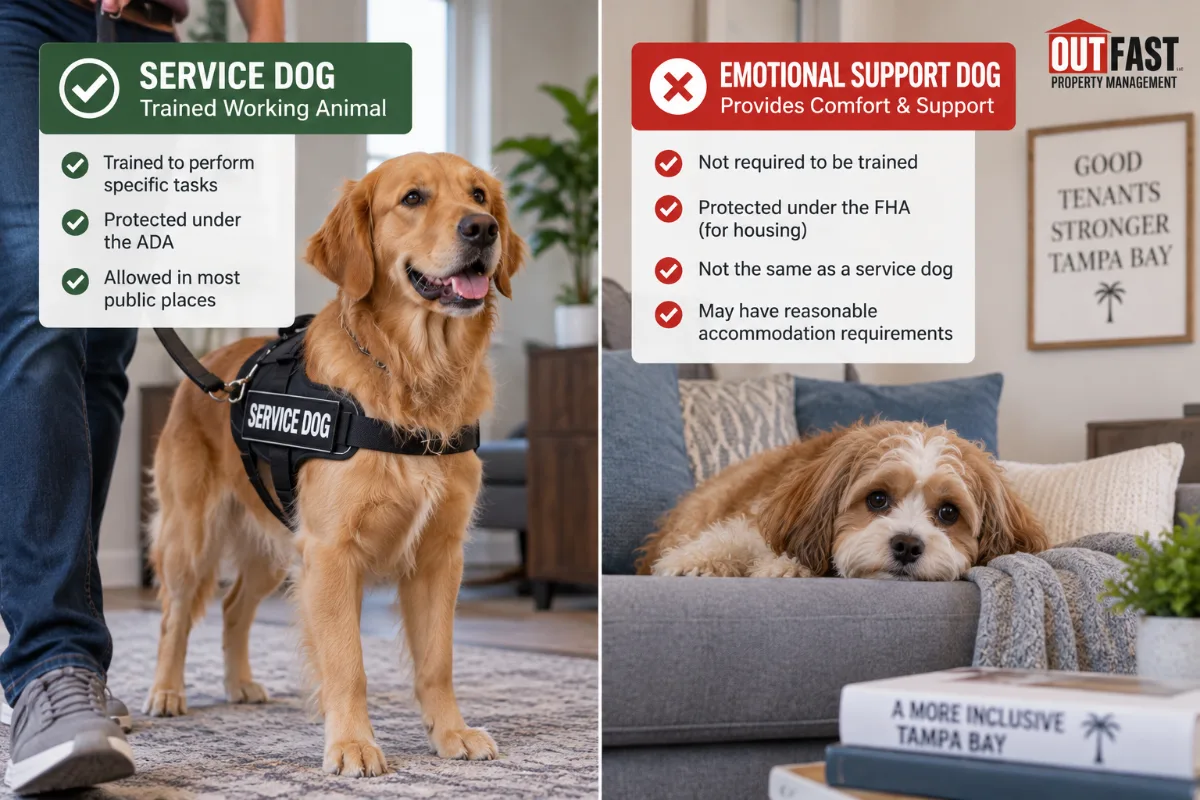
The second thing Tampa Bay owners get wrong is reaching for the ADA’s service animal rules — the familiar “two questions” script. That script belongs to restaurants, hotels and shops, not to a lease.
Three categories, and why they are not interchangeable
Most disputes start when an owner collapses three legal categories into one.
A service animal is individually trained to do work or tasks directly related to a disability. Fla. Stat. 413.08 defines one for Florida purposes, limits it to a dog or miniature horse in public accommodation settings, and confirms no extra compensation may be charged in housing. An assistance animal is the broader Fair Housing Act category covering both trained service animals and untrained emotional support animals. A pet is everything else, and your pet rules apply in full.
| Service animal (ADA) | Assistance animal / ESA (FHA + Florida law) | Pet | |
|---|---|---|---|
| What it is | Dog individually trained to do work or tasks tied to a disability; separate provision for miniature horses | Trained service animal or an untrained animal that eases identified symptoms of a disability by its presence (760.27) | Any animal kept for companionship, with no disability nexus |
| What you may ask | Two questions only: is it required because of a disability, and what task is it trained to perform | If the disability or the need is not readily apparent, reliable supporting information under 760.27(2)(b) and (2)(c); plus licensing and vaccination proof | Anything lawful — breed, size, vet records, references |
| Fees and deposits | No deposit or surcharge | No pet fee, pet deposit or pet rent; tenant still liable for actual damage | Pet fee, pet deposit and pet rent all permitted |
| Breed and weight limits | Cannot be applied categorically | Cannot be applied categorically; assess the individual animal’s conduct | Apply your policy freely |
Once you approve an assistance animal, a pet fee, pet deposit or monthly pet rent for that animal violates Florida law — 760.27(2) and 413.08(6)(b) both bar extra compensation. It is the most expensive mistake in Florida rentals, and easy to make by running the animal through your normal ledger. Set the fee to zero at approval.
What changed in 2026 — and what did not
Recent commentary overstates this in both directions.
On 17 September 2025 HUD withdrew a group of fair housing guidance documents, including the 2013 and 2020 assistance animal notices. HUD’s May 2026 enforcement guidance then permanently rescinded the 2020 notice and announced that HUD will find reasonable cause only where an animal is individually trained to perform work or tasks directly related to the complainant’s disability. Requests to waive a pet policy for a trained animal are presumptively reasonable; requests for untrained emotional support animals are not.
Here is what that memorandum did not do. It did not amend the Fair Housing Act, change HUD’s regulations, or touch Part II of Chapter 760, the Florida Fair Housing Act. It expressly preserved a tenant’s right to sue privately in federal or state court within two years. And it has no effect on Florida’s ESA statute, which the Legislature passed in 2020 and has not amended since.
HUD changed which complaints it will pursue, not what the law requires. Your duties still come from the Fair Housing Act itself and from 760.27 — neither of which HUD rescinded or could rescind. Tenants can still sue privately and still file with the state. Nothing about 2026 makes a blanket “no ESAs” policy safe in Florida.
Questions you may and may not ask
The trigger for any documentation request is whether the disability, or the need, is readily apparent. If a tenant is blind and the dog is in a guide harness, you ask nothing. Otherwise you may ask — carefully.
You may ask:
- Whether the animal is needed because of a disability, and what the animal does for the tenant
- For reliable information supporting that the tenant has a disability, where that is not apparent
- For reliable information supporting the need for that particular animal, where that is not apparent
- For the specific need for each animal, if more than one is requested
- For proof of compliance with state and local licensing and vaccination requirements
You may not ask:
- For a diagnosis, or for the severity of the disability
- For medical records of any kind
- That the tenant use your specific form, or provide a notarised statement
- That the animal demonstrate its training, or produce training credentials
- For anything at all where the disability and the need are both obvious
A tenant may volunteer medical detail — 760.27(3)(a) permits that at their discretion — but you cannot require it. And under 760.27(3)(b), you may publish a routine intake method, yet cannot deny a request solely because the tenant did not follow it.
Documentation: what makes a letter acceptable under Fla. Stat. 760.27
Florida is unusually specific here — a gift to owners who read the statute.
Where the disability is not readily apparent, subsection (2)(b) lists what counts as reliable supporting information: a determination of disability from a federal, state or local government agency; receipt of disability benefits or services from such an agency; proof of eligibility for housing assistance or a voucher received because of a disability; or information from a health care practitioner as defined in s. 456.001 or a telehealth provider as defined in s. 456.47.
Two qualifiers matter. Information is reliable only where the practitioner has personal knowledge of the person’s disability and is acting within the scope of their practice. And an out-of-state practitioner counts only if they have provided in-person care to the tenant at least once — the clause that disposes of most purchased internet letters.
Where the need for the particular animal is not readily apparent, subsection (2)(c) allows a request for information identifying the specific assistance or therapeutic support that animal provides.
It comes from a licensed practitioner with a real treating relationship with the tenant. It confirms a disability without naming a diagnosis, explains what the animal does, and identifies the specific animal. If the practitioner is out of state, there has been at least one in-person visit. What it does not need: your form, a notary, a registration number, or a vest.
When a request may lawfully be denied
Denials are legitimate — they simply have to be reasoned, individual and documented.
Direct threat. Under 760.27(2)(a) you may deny where the specific animal poses a direct threat to the health or safety of others, or of physical damage to the property of others, and that threat cannot be reduced or eliminated by another reasonable accommodation. This turns on the animal’s actual conduct and history, not its breed.
Undue financial and administrative burden and fundamental alteration of your operation are the other recognised grounds. Both are demanding standards, rarely met by an ordinary rental home.
Insufficient reliable information is the practical one. If the disability is not apparent, you asked properly, and the tenant supplied nothing meeting the statute, you may deny — after a genuine opportunity to cure.
Running through all of it is the individualised assessment. “We don’t allow pit bulls” is not an assessment. “This dog has bitten twice, here are the incident reports, and no alternative reduces the risk” is. Categorical breed and weight rules are where owners lose. Insurance pressure does not change that, though your carrier’s position is worth reviewing — the same due diligence that serves you well when buying your first rental property.
When you suspect a fraudulent letter
It happens, and Florida gives you a framework rather than a veto.
Under 760.27(3)(c), an ESA registration of any kind — card, patch, certificate or online registration — is not by itself sufficient to establish a disability or a need. A request supported only by a downloaded certificate has not met the standard, so you may request the reliable information the statute allows.
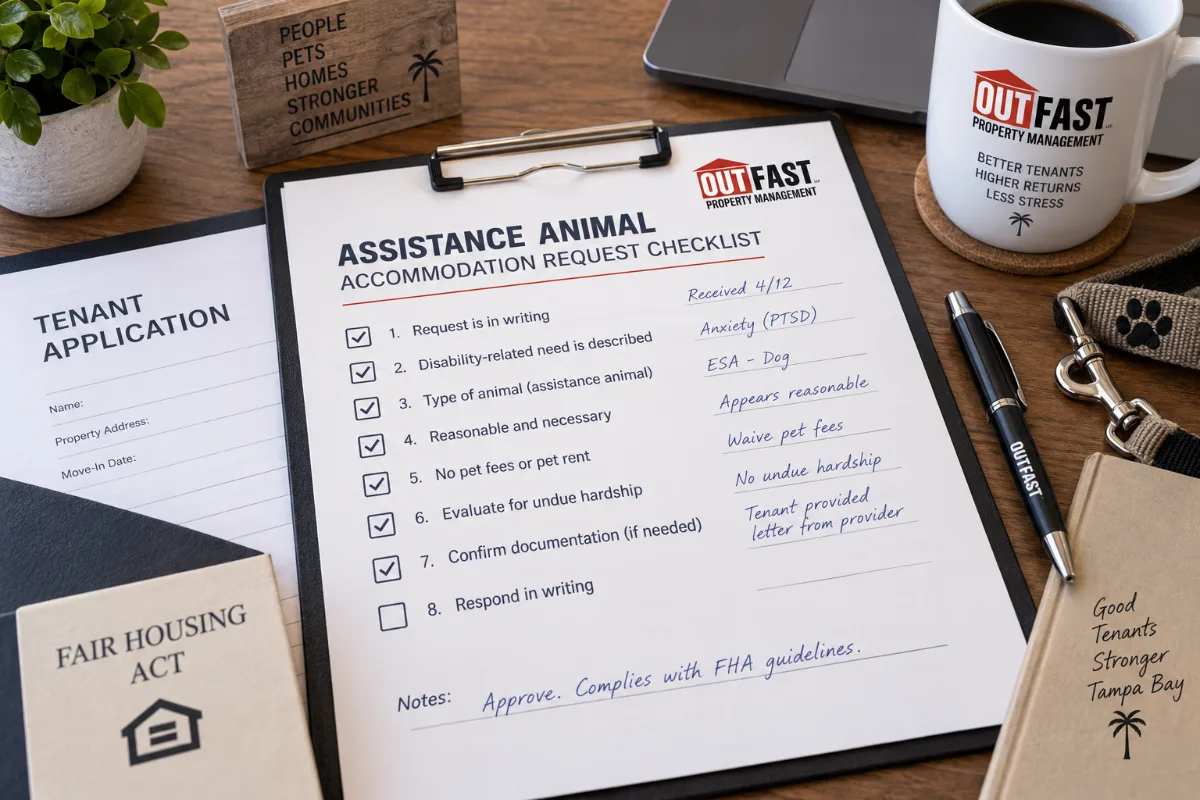
What you should not do is accuse. Ask in writing for the supporting information subsection (2) permits, with a reasonable deadline. Verify the practitioner is licensed and in good standing. If out of state, ask whether there has been an in-person visit.
Deliberate fraud is a crime here. Fla. Stat. 817.265 makes falsifying documentation for an emotional support animal, or knowingly misrepresenting oneself as having a disability or disability-related need, a second-degree misdemeanour, plus 30 hours of community service within six months of conviction. That is a matter for prosecutors, not a landlord acting unilaterally.
Record the date of the request, exactly what you asked for and when, what the tenant supplied, who you verified and how, and the reasons for your decision. Fair housing cases are won and lost on contemporaneous documentation.
Which Florida dwellings are actually exempt
Narrower than most owners hope. Fla. Stat. 760.29(1)(a) provides that sections 760.23, 760.25 and 760.27 do not apply to a single-family house sold or rented by its owner where that owner holds no more than three single-family houses at a time — and only where it is rented without a real estate licensee or anyone in the business of renting dwellings, and without discriminatory advertising. It also exempts a dwelling for no more than four families living independently where the owner occupies one unit: the Mrs. Murphy exemption. Florida’s exemptions closely track the federal ones.
Note the trap: engage a property manager or leasing agent and the single-family exemption is gone.
A process that holds up
Take every request in writing. If the disability and need are readily apparent, approve and move on. If not, request only what 760.27 permits, in writing. Evaluate the response against the statute, not your instinct. Approve or deny in writing, with reasons. Waive the pet fee at approval. Then treat the animal like any other resident’s — the tenant is fully liable for damage, and lease terms on nuisance, noise and control still apply. Keep the file as complete as the one you would keep for a deposit dispute under Florida security deposit law.
Complaints can go to the Florida Commission on Human Relations, generally within one year of the alleged violation, or to federal court within two years. Neither is a place to discover your process was informal.
Out Fast Property Management handles assistance animal requests across Hillsborough and Pinellas every week — written intake, statute-compliant documentation requests, practitioner verification, and a decision file that stands up. If a request is on your desk and you are not certain, call us before you answer it. A review costs nothing. A fair housing complaint does not.
Frequently Asked Questions
Can a landlord deny an emotional support animal in Florida?
Sometimes, but never because of breed, weight, or a blanket no-pet policy. Under Fla. Stat. 760.27(2)(a), a Florida housing provider may deny a request where the specific animal poses a direct threat to the health or safety of others, or a direct threat of physical damage to the property of others, and that threat cannot be reduced or eliminated by another reasonable accommodation. A request may also be denied if the tenant, after being asked, does not supply reliable supporting information where the disability or the need is not readily apparent. Every denial has to rest on an individualised assessment of that animal and that request.
What documentation can a Florida landlord request for an ESA?
Only when the disability or the disability-related need is not readily apparent. If the disability is not obvious, Fla. Stat. 760.27(2)(b) permits a request for reliable information such as a determination of disability from a federal, state or local government agency; receipt of disability benefits or services from such an agency; proof of eligibility for housing assistance or a voucher received because of a disability; or information from a health care practitioner as defined in s. 456.001 or a telehealth provider as defined in s. 456.47. If the need for the animal is not obvious, subsection (2)(c) permits a request for information identifying the particular assistance or therapeutic support that specific animal provides. You may also require proof of licensing and vaccination, and where more than one animal is requested, information about the specific need for each animal.
Is an online ESA registration or certificate enough?
No. Fla. Stat. 760.27(3)(c) states plainly that an ESA registration of any kind — an identification card, patch, certificate or similar registration obtained from the internet — is not, by itself, sufficient to reliably establish either a disability or a disability-related need. That said, you cannot reject a request simply because a certificate was attached. Ask for the reliable supporting information the statute allows and evaluate that.
Can I charge a pet fee or pet deposit for an emotional support animal?
Not once the animal is approved as an assistance animal. Fla. Stat. 760.27(2) says such a person “may not be required to pay extra compensation for such animal,” and Fla. Stat. 413.08(6)(b) says the same for service animals in housing. That covers pet fees, pet deposits and monthly pet rent. The tenant does remain liable under 760.27(4) for any damage the animal does to the premises or to another person on the premises, and you can pursue that damage the same way you would any other.
What is the difference between a service animal and an emotional support animal?
A service animal is individually trained to do work or perform tasks directly related to a person’s disability — guiding, alerting to sounds, interrupting a seizure, retrieving items. Under the ADA that means a dog, with a separate provision for miniature horses. An emotional support animal is defined in Fla. Stat. 760.27(1)(a) as an animal that does not require training and helps by virtue of its presence, alleviating one or more identified symptoms of a disability. Both can be assistance animals in housing; only the trained one is a service animal.
Do the ADA’s two questions apply to my rental property?
No, and this is the single most common mistake. The two-question script — is the dog a service animal required because of a disability, and what work or task has it been trained to perform — comes from the ADA rules for public accommodations such as restaurants, hotels and shops. A private rental home is not a public accommodation. In a Florida rental you work from the Fair Housing Act and Fla. Stat. 760.27, which allow a different and somewhat broader documentation request when a disability is not readily apparent.
Did the 2026 HUD changes end emotional support animal rights in Florida?
No. In September 2025 HUD withdrew its 2013 and 2020 assistance animal notices, and on 22 May 2026 HUD permanently rescinded the 2020 notice and announced it will find reasonable cause only where an animal is individually trained. That is a change in federal enforcement priorities. It did not amend the Fair Housing Act, it did not repeal Florida’s statute, and it expressly preserved a tenant’s private right to sue. Florida’s ESA statute remains on the books, and complaints can still be filed with the state. Treat 760.27 as live law.
Which Florida rentals are exempt from the fair housing rules on ESAs?
A narrow set. Fla. Stat. 760.29(1)(a) provides that sections 760.23, 760.25 and 760.27 do not apply to a single-family house sold or rented by its owner where that private individual owner owns no more than three single-family houses at a time, and only if it is rented without a real estate licensee or anyone in the business of renting dwellings and without discriminatory advertising. It also exempts rooms or units in a dwelling for no more than four families living independently where the owner actually occupies one of the units — the so-called Mrs. Murphy exemption. If you use a property manager or a leasing agent, you are almost certainly outside the exemption.


