


Every lease that nears its end is a small business decision. Renew at the right rent and you keep a paying tenant and avoid the single most expensive event in property management – a vacancy. Handle it poorly and you risk turnover, lost rent, and make-ready costs that can wipe out months of profit. For Tampa Bay owners, this guide breaks down when and how to offer a renewal, how to set a fair increase, and the notice timing Florida law expects.
Why renewals are an owner’s biggest money lever
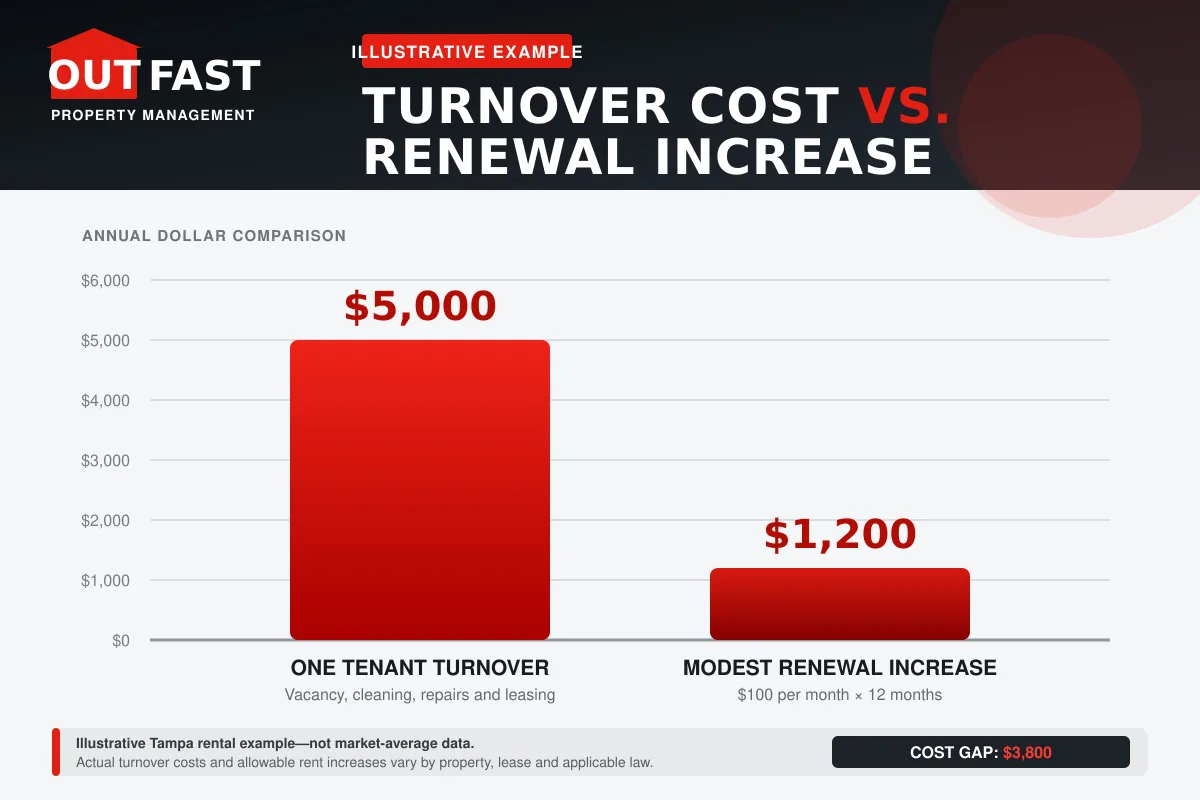
Turnover is costly. Between lost rent during vacancy, cleaning, paint, marketing, and screening a new applicant, a single turnover in the Tampa market can easily run one to two months of rent. A renewal at a modest, market-justified increase almost always beats chasing a slightly higher rent with a new tenant.
That is why retention is a money strategy, not just a courtesy. Keeping a reliable tenant one more year protects cash flow and compounds over time.
A $2,000/month rental that sits empty for six weeks and needs $1,500 in make-ready costs loses roughly $4,500. A renewal at even a flat rent often out-earns re-renting at $100 more per month.
Start the renewal conversation early
Begin 60 to 90 days before the lease expires. Early outreach does three things: it signals you value the tenant, it gives you time to re-market if they decline, and it gets ahead of any lease renewal notice the lease itself requires. Waiting until the final weeks forces rushed decisions and raises the odds of an unplanned vacancy.
A good sequence: a friendly check-in, then a formal renewal offer in writing, then a follow-up before the deadline.
Setting a fair rent increase at renewal
Florida has no statewide rent cap, but “legal” and “smart” are different questions. Price the renewal against reality:
- Pull local comps. What are comparable Tampa Bay units renting for today? Zillow, Rentometer, and recent leases in the area give you a range.
- Weigh the tenant’s value. On-time payment, good property care, and low maintenance demands are worth real money. A retention discount to a great tenant is a rational business choice.
- Keep increases defensible. Modest, market-aligned bumps renew; aggressive jumps trigger move-outs and vacancy. Under current florida rent increase laws there is no cap, but the market disciplines what actually sticks.
When calculating your net yield, remember to factor professional fees into your annual operating budget so you know exactly what property managers charge in Florida when placing and renewing high-quality residents.
Renewal notice timing under Florida law
Two rules matter most for Tampa Bay landlords:
- Non-renewal of a fixed-term lease (Fla. Stat. 83.575). A lease may require the tenant to give written notice – up to 60 days – before the end of the term if they do not plan to renew. If your lease has this clause and discloses it properly, hold tenants to it, and honor any matching obligation it places on you.
- Month-to-month tenancies (Fla. Stat. 83.57). At least 15 days’ written notice before the end of a monthly period is required to end the tenancy or change terms. Some Tampa Bay localities have added longer notice windows for sizable rent increases, so confirm current city and county ordinances.
When a fixed-term lease simply expires with no renewal signed and the tenant stays with your consent, the tenancy typically converts to month-to-month – a lease renewal vs month to month fork worth deciding on purpose rather than by accident.
Lease renewal vs. month-to-month
Both have a place:
- Fixed-term renewal locks in income and the tenant for another year – ideal when you want stability and a known good resident.
- Month-to-month gives flexibility (useful if you may sell or renovate) and often supports a rent premium, but invites higher turnover and shorter notice on both sides.
Choose based on your plan for the property, not habit. Keep in mind that fixed-term commitments also come with specific legal considerations if a tenant needs to move early, so ensure you understand the rules around breaking a lease in Florida before deciding on term length.
Writing a renewal offer that gets signed
Your lease renewal letter should be clear and easy to say yes to: the new term length, the new rent and its effective date, any changed terms, the acceptance deadline, and simple signing instructions. Reaffirm the security deposit’s status while you are at it – it is a natural moment to confirm the account is in order under Florida security deposit law. A clean, professional offer removes friction and keeps good tenants in place.
Retention tactics that keep units occupied
Rent is only part of the renewal decision. Tenants stay where they feel cared for:
- Respond to maintenance quickly all year – responsiveness is remembered at renewal time.
- Offer a small, visible improvement (new fixtures, a fresh coat in a high-wear room) in exchange for a longer term.
- Consider a modest loyalty concession for multi-year renewals.
These cost far less than a turnover and directly protect your occupancy rate.
The bottom line
Treat every renewal as the profit event it is: start early, price the increase to the Tampa market, follow Florida’s notice rules, and give good tenants a reason to stay. Do that consistently and your units stay occupied, your rents stay optimized, and your returns stay predictable.
Out Fast Property Management handles renewals, market-based rent reviews, and notice compliance for Tampa Bay owners so your units stay occupied and profitable. Ask us about our renewal and retention process.
Frequently Asked Questions
How much notice must a Florida landlord give to not renew a lease?
Florida Statute 83.575 lets a lease require the tenant to give up to 60 days’ written notice before the end of the term if they do not intend to renew – and, if the lease includes it, the landlord may owe similar notice. Absent that clause, a fixed-term lease simply ends on its stated date. Always check your specific lease language.
How much can a landlord raise rent at renewal in Florida?
Florida has no statewide rent control and no cap on how much rent can increase at renewal. During a fixed-term lease the rent is locked; increases apply at renewal or on a month-to-month tenancy. A few local ordinances add notice requirements, so confirm your county and city rules.
What notice is required to raise rent on a month-to-month tenant?
For a month-to-month tenancy, Florida law requires at least 15 days’ written notice before the end of a monthly period to change terms or end the tenancy. Some Tampa Bay jurisdictions have adopted longer notice periods for larger increases, so verify local rules.
Is a lease renewal better than going month-to-month?
A renewal locks in a known tenant and rent for a fixed term – more income stability and no surprise vacancies. Month-to-month offers flexibility and often a rent premium, but carries higher turnover risk. The right choice depends on your goals for that unit.
What should a lease renewal letter include?
The proposed new term, the new rent amount and effective date, any changed terms, the deadline to accept, and how to sign. Sending it 60-90 days before expiration gives the tenant time to decide and protects your occupancy.


