

Florida does not have a rent grace period. Rent is due on the date your lease says it is due, and state law does not give tenants extra days or cap the late fee a landlord may charge. Whatever grace period and late fee a Tampa Bay tenant has comes from the signed lease, and the only fixed timeline in the statute is the 3-day notice a landlord must give before ending the tenancy for nonpayment.
That makes your lease language and your process the two things that matter. Below we cover what the law says, how to set a fair late fee, what happens with NSF checks and partial payments, and a lease checklist you can use.
General information, not legal advice. Current as of October 28, 2026. Landlord-tenant rules change, so confirm with a Florida attorney before acting on a specific situation.
When is rent legally late in Florida?
Under Fla. Stat. 83.46, unless the parties agree otherwise, rent is due without any demand or notice from the landlord, at the start of each rental period. In practice that means rent is late the day after the due date written in your lease, unless the lease builds in a grace period.
There are two different ideas people mix up:
- A lease grace period is a contractual number of days (leases often use 3 to 5) during which rent can arrive without a late fee.
- The 3-day notice period is the statutory window a tenant has to pay or leave after the landlord serves a written demand. It is not a grace period, and it does not stop rent from being late.
If your lease says rent is due on the 1st with a grace period through the 5th, treat the 6th as the first day a late fee applies, and do not serve a termination notice before then. A landlord who promised a grace period and then rushes to file creates their own defense problem.
Can a Florida landlord charge a late fee?
Yes, if the lease says so. Florida does not set a statewide cap on residential late fees, so the signed rental agreement controls. That freedom has limits.
Put it in writing. The fee amount, when it starts and how it is calculated should be stated plainly in the lease. A fee you never agreed to in writing is hard to defend.
Keep it reasonable. Under Fla. Stat. 83.45, a court that finds a rental agreement or one of its provisions unconscionable may refuse to enforce it, enforce the rest of the lease without it or limit its application. A fee that looks like a penalty rather than compensation for a real cost is the type of clause that gets challenged.
Pick a structure and a cap. The common models are:
| Structure | Example | Watch out for |
|---|---|---|
| Flat fee | A single fee once the grace period ends | Easy to understand, easy to enforce |
| Percentage of rent | A set percent of monthly rent | Scales with rent, but check that it stays reasonable |
| Daily fee | A smaller fee for each day late | Add a maximum so it cannot snowball |
| Flat plus daily | Initial fee plus a daily amount | Most complex, most likely to look like a penalty |
We do not recommend a number, because the right figure depends on your rent level, your costs and your attorney’s advice. We do recommend a flat fee or a capped percentage over an open-ended daily charge.
Waiving the late fee for one tenant and charging it to the next invites disputes and fair housing questions. Decide your policy, put it in the lease and apply it consistently. If you want to make a one-time exception, document it in writing.
The 3-day notice: where late fees and rent part ways
When rent stays unpaid, Fla. Stat. 83.56(3) lets the landlord terminate the rental agreement if the default continues for 3 days after a written demand is delivered. Saturdays, Sundays and court-observed legal holidays do not count. The notice follows a statutory form: it states that the tenant owes a specified sum “for the rent and use of the premises,” demands payment or possession within 3 days, and lists the landlord’s name, address and phone number.
Here is the trap. The notice demands rent. Fla. Stat. 83.43 defines rent as the periodic payments for occupancy, plus other payments designated as rent in the written rental agreement. If your lease calls late fees “additional rent,” you may have an argument for including them. But many Florida eviction attorneys advise leaving late fees and other charges off the notice, because overstating the amount owed can make the notice defective, which forces you to start over and costs you days. When in doubt, demand the base rent only and pursue other charges separately.
For the rest of the process after the notice, see our Florida eviction process guide. Keep the eviction details with an attorney or a manager who handles filings every week.
Partial rent payments: how not to lose your position
Partial payments are where good landlords make avoidable mistakes. The rules in Fla. Stat. 83.56(5)(a) are:
- If a landlord accepts rent with knowledge of a violation, they generally waive the right to terminate for that violation. The waiver does not extend to later or continuing violations.
- Accepting partial rent does not waive your right to terminate or sue.
- If you accept partial rent after serving a 3-day notice, you must do one of three things: give the tenant a receipt showing the date, the amount received, the agreed date and the remaining balance, before filing for possession; deposit the partial payment into the court registry when you file; or post a new 3-day notice reflecting the new amount owed.
Accepting a partial payment without following one of those paths can undermine an eviction filing. Decide your partial payment policy in advance and write it into the lease, including that acceptance is not a waiver and that the tenant remains responsible for the balance. If the tenant receives a rent subsidy, different waiver rules apply to the subsidized portion, so get advice.

NSF fees and returned rent checks
If a rent check bounces, you may recover the bank fees you actually paid, plus a statutory service charge, under Fla. Stat. 68.065. The service charge is $25 on instruments of $50 or less, $30 over $50 up to $300, and $40 over $300, or 5% of the face value, whichever is greater. A written demand by certified or first-class mail with proof of mailing starts a 30-day period to pay the full amount; if unpaid, the payee may sue for up to triple the amount owed (minimum $50) plus costs and attorney fees, though courts can reduce damages in cases of economic hardship.
Two practical points. First, a returned check is not rent paid, so the late-rent clock keeps running. Second, the simplest solution is to accept rent only through electronic payment. Online payments remove most NSF disputes and give you a clean payment history for every tenant.
What changed in 2026 (and what did not)
You may have seen headlines about changing the notice period or limiting fees. As of October 28, 2026:
- SB 716, which would have changed the rent payment deadline from 3 days to 5 days and barred fees during that period, died in committee on March 13, 2026, along with its House companion. It is not law.
- CS/HB 1293 (ch. 2026-143), effective October 1, 2026, amended Fla. Stat. 83.56(2)(a) only to address fraudulent entry into a rental using false identity or forged documents. It did not change rent, late fees or partial payments.
- The 3-day nonpayment notice in Fla. Stat. 83.56(3) remains the rule.
A lease checklist for rent and late fees
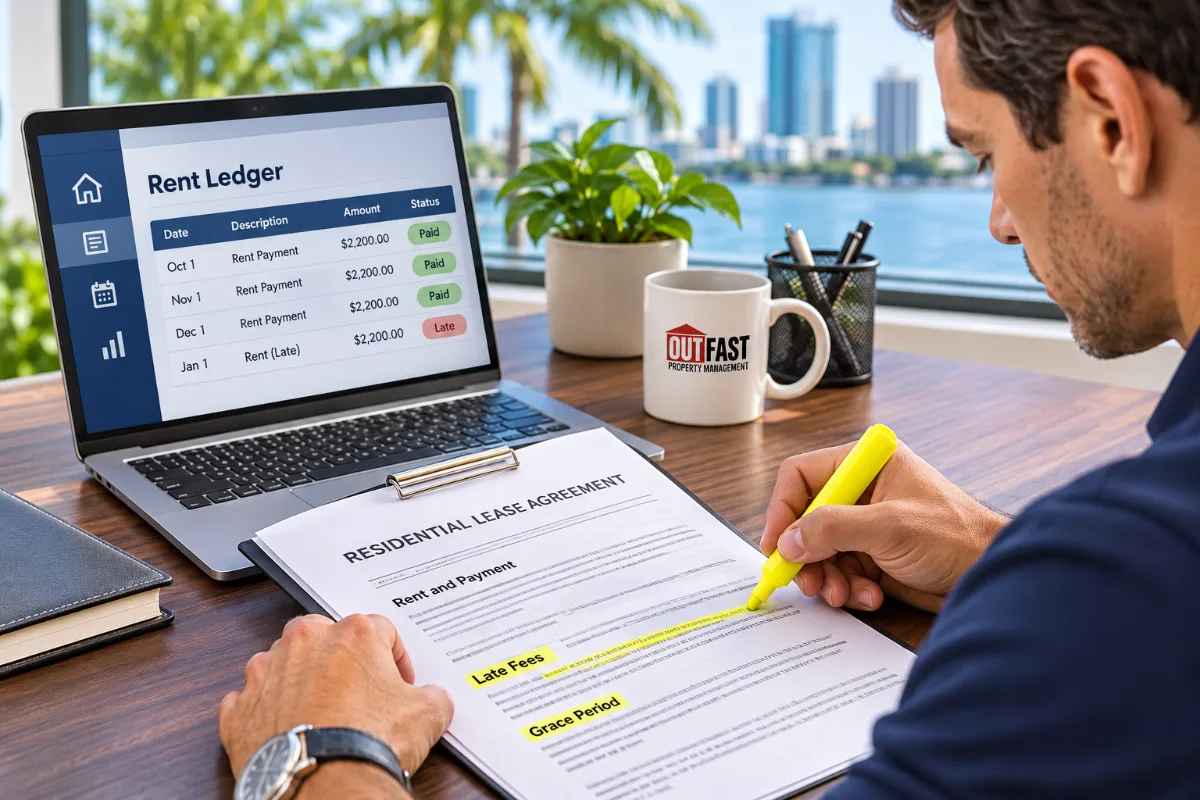
Before you sign your next lease or renewal, confirm it covers:
- The due date and acceptable payment methods.
- A grace period, if any, stated in days.
- The late fee amount, how it is calculated and the maximum.
- Whether late fees are designated as rent (ask your attorney if you want that).
- The NSF or returned payment fee and bank charges.
- A partial payment policy and a no-waiver clause.
- How notices are delivered to the tenant.
- What the tenant owes if they pay late repeatedly, and your renewal approach, which ties into our Florida lease renewal guide.
Strong tenant screening also lowers late-rent risk before the lease is signed, and if you raise rent at renewal, review the Florida rent increase laws so the notice is handled correctly.
Out Fast Property Management handles rent collection, late-fee enforcement and notices for Tampa Bay owners, so every tenant is treated consistently and your paperwork is ready if a case goes further. See our property management services or talk to our Tampa Bay team.
Frequently Asked Questions
Does Florida require a grace period for rent?
No. Florida has no statutory grace period for residential rent. Under Fla. Stat. 83.46, rent is due when the lease says it is due. Any grace period before a late fee applies comes from the lease, not from state law.
How much can a Florida landlord charge for a late fee?
Florida sets no statewide dollar or percentage cap on residential late fees, so the signed lease controls. The fee should be spelled out in writing and be reasonable. A court can refuse to enforce a lease provision it finds unconscionable under Fla. Stat. 83.45.
When can a Florida landlord serve a 3-day notice for unpaid rent?
Once rent is due and unpaid. Under Fla. Stat. 83.56(3), the tenant has 3 days after delivery of the written demand, excluding Saturdays, Sundays and court-observed legal holidays, to pay or move out. If your lease gives a grace period, honor it before serving the notice.
Can I put the late fee on the 3-day notice?
Be careful. The statutory form demands rent “for the rent and use of the premises.” Fla. Stat. 83.43 defines rent to include other payments designated as rent in the written lease, but many Florida eviction attorneys advise leaving late fees off the notice, because an overstated demand can invalidate it. Ask your attorney before including them.
If I accept a partial rent payment, do I lose the right to evict?
Not automatically. Fla. Stat. 83.56(5)(a) says accepting partial rent does not waive your rights. After a 3-day notice, though, you must give the tenant a dated receipt showing the balance, deposit the partial payment into the court registry when you file, or serve a new 3-day notice for the new amount.
What can I charge for a returned (NSF) rent check in Florida?
Under Fla. Stat. 68.065, a payee can collect bank fees actually incurred plus a service charge of $25 (checks of $50 or less), $30 (over $50 up to $300) or $40 (over $300), or 5% of the face value, whichever is greater. Check your lease and your attorney’s advice on how this interacts with a contractual NSF fee.


