

This article is general information for Florida rental property owners and is not legal advice. Rental restrictions turn on the exact wording of your recorded documents and when they were recorded. Have a licensed Florida community association attorney review your declaration before you list. Current as of September 2026 – always verify against the official Florida Statutes.
Can your HOA stop you renting your property? Often yes – and sometimes no, even when the board insists otherwise. Florida law turns on when the restriction was recorded and whether you consented. A leasing ban adopted before you bought binds you. One amended in after you bought, which you never voted for, generally does not. Get that timeline wrong and you either surrender income you were entitled to earn, or sign a lease your association can refuse to honor.
That is the whole game with hoa rental restrictions in Tampa Bay. Below is the pre-lease due diligence Out Fast runs on every Hillsborough and Pinellas rental.
The consent rule that protects existing owners
Start here, because it decides everything else.
For condominiums, section 718.110(13) provides that an amendment prohibiting owners from renting, altering the duration of the rental term, or limiting the number of times owners may rent applies only to unit owners who consent and those who acquire title after its effective date.
For homeowners’ associations, section 720.306(1)(h) does the same for any governing document or amendment enacted after July 1, 2021: it applies only to a parcel owner who takes title after the effective date, or who consents individually or through a representative.
But two HOA carve-outs bind everyone: an association may amend to prohibit or regulate rentals of less than 6 months, and may prohibit renting more than three times in a calendar year, and both apply to all parcel owners regardless of consent. Long-term leasing is well protected; seasonal and short-term income is not. Note too that conveying to an affiliated entity, or an heir becoming the owner, is not a change of ownership that strips grandfathered rights.
Silence is not consent. If you never voted for it and owned before it passed, say so in writing, early.
Pull your recorded deed and the recorded amendment side by side. Compare the deed’s recording date to the amendment’s effective date – not the date the board announced it. That single pairing decides whether the restriction reaches you at all.
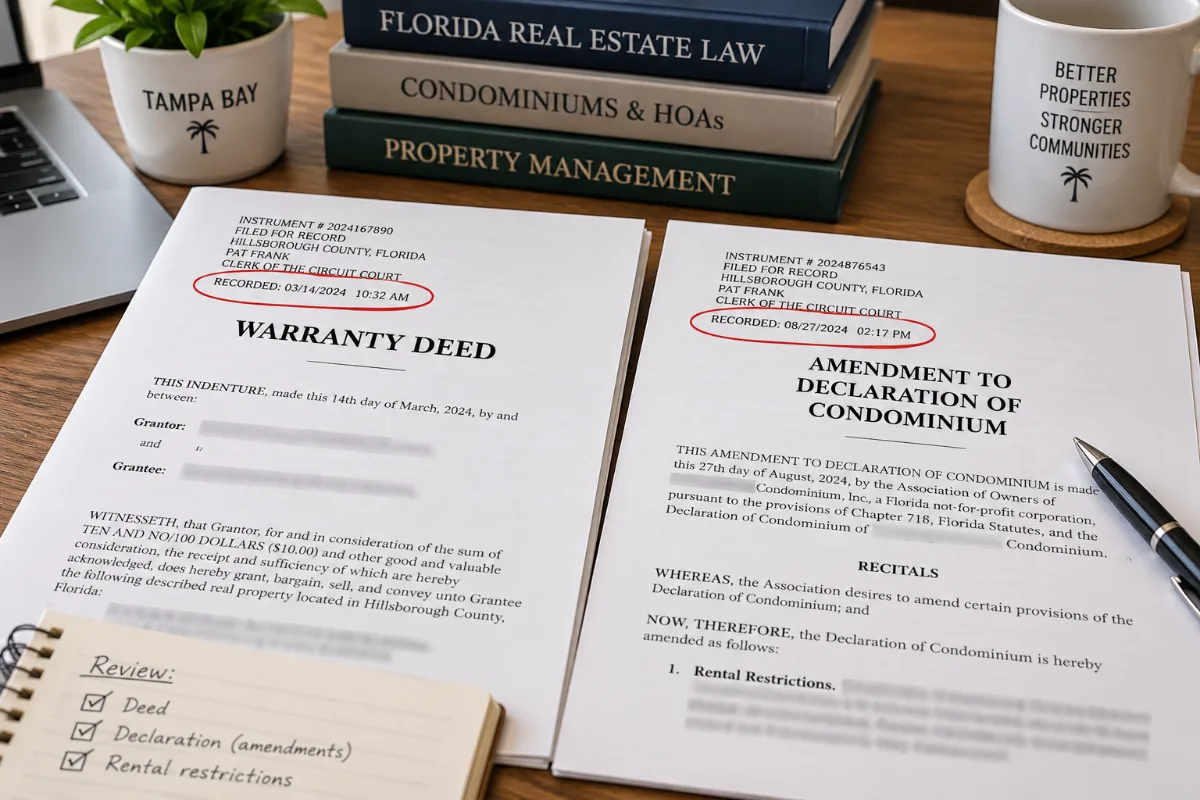
Your pre-lease due-diligence checklist
Rules posted on the community portal are the least authoritative document in the stack. Pull the recorded ones.
| Document to pull | What you are looking for |
|---|---|
| Recorded declaration (condominium or covenants) | The leasing clause: is leasing permitted, restricted, or silent? Silence usually means permitted |
| Every recorded amendment since the original | Rental caps, minimum terms, waiting periods, approval rights – and each amendment’s effective date |
| Bylaws and articles of incorporation | Whether an approval fee or lessee security deposit is actually authorized |
| Rules and regulations | Conduct rules your tenant will be fined over: parking, pets, trash, guests, amenity use |
| Association leasing application packet | Forms, disclosures, fees, the submission deadline, and which meeting your file must reach |
| Recent board and membership meeting minutes | Amendments in progress, a cap that is full, or a waiting list you did not know existed |
| Your recorded deed / closing package | The date you took title – the anchor for the consent analysis above |
| Estoppel certificate or account statement | Whether you are delinquent, and whether a violation is already noticed against your unit |
Board minutes are where you learn a rental cap is at its ceiling before you spend money on photos, and the estoppel certificate is where you learn about an open violation you never received.
The four restrictions that actually stop a lease
| Restriction type | What it means for you as an owner |
|---|---|
| Rental cap | Only a fixed number or percentage of units may be leased at once. If the cap is full you join a waiting list, and there is no legal remedy – the unit cannot be leased until a slot opens |
| Minimum lease term | A floor on term length (commonly 30 days, 3, 6 or 12 months). This kills short-term and seasonal plans, and for HOAs the sub-6-month version binds every owner |
| Waiting period after purchase | “No leasing for the first 12 (or 24) months of ownership.” Devastating if you bought as an investment, because it does not expire early for hardship |
| Board approval requirement | The association must approve the tenant before occupancy. Adds weeks to your timeline and gives the board a reason to say no |
If you are still shopping rather than leasing, this checklist belongs in your diligence period – we cover the wider version in our guide to buying your first rental property.
Board approval of your tenant
A fact that surprises owners: neither Chapter 718 nor Chapter 720 contains a tenant-screening scheme. There is no statutory list of what an association may check, no credit or criminal standard, and – importantly – no statutory deadline to respond. The approval right exists only because the recorded documents created one.
So the process is whatever those documents say, constrained by fair housing law. Tampa Bay associations commonly require an application per adult occupant, a background and credit check, the proposed lease, and sometimes an interview. Extract the narrow facts: who approves, when they meet, what makes a package “complete,” and what grounds are stated for denial.
One ground is explicit in statute. Section 718.116(4) provides that where the association may approve or disapprove a proposed lease, the grounds for disapproval may include the owner being delinquent in paying an assessment at the time approval is sought. Clear your ledger before you apply.
Use an approval contingency, or do not sign. If you execute a lease and the association then denies your tenant, you are exposed on both sides – a tenant with a signed lease and no lawful right to occupy, and an association that can pursue you for an unapproved occupancy. Get the written approval first, then countersign.
Fees: what may actually be charged
Florida caps this tightly for condominiums, and associations working from an outdated fee schedule frequently exceed the caps. Section 718.112(2)(k) permits a transfer or approval fee only where the association is required to approve the transfer and the fee is provided for in the declaration, articles or bylaws. The cap is $150 per applicant, with spouses or a parent and dependent children treated as one applicant, and on a renewal with the same lessee no charge may be made at all. It also lets a condominium association require a prospective lessee to place a security deposit of no more than one month’s rent into an association escrow account, protecting only against damage to the common elements or association property. For the parallel rules on the deposit you hold, see our explainer on Florida security deposit law.
Two cautions. That $150 figure is CPI-adjusted every five years and republished by DBPR, so verify the published amount. And Chapter 720 sets no equivalent cap – an HOA’s leasing fee authority comes from its governing documents.
When an association quotes a fee, ask which recorded provision authorizes it. A fee not authorized in the declaration, articles or bylaws is not chargeable at all – regardless of the management company’s fee schedule.
Estoppel certificates
An estoppel certificate is your snapshot of what the association says is owed and what is open against the unit. Under the condominium estoppel statute and its Chapter 720 twin, the association must issue it within 10 business days of a written or electronic request, and if it misses that deadline no fee may be charged. Certificates are effective 30 days if hand-delivered or emailed, 35 days by regular mail.
The cap is $250 where nothing is delinquent, up to $100 more for expedited delivery within three business days, and no more than an additional $150 where a delinquency exists – all CPI-adjusted and republished by DBPR. Read the open-violation question on the form: it is how many owners first discover a problem that would have blocked their lease.

Fines, and who is actually liable
For condominiums, section 718.303(3) caps a fine at $100 per violation and $1,000 in the aggregate, and a condominium fine may not become a lien against the unit. Now read the HOA fine and suspension statute, which uses the same $100 / $1,000 figures but adds four words that matter enormously: unless otherwise provided in the governing documents. An HOA declaration can raise both numbers – and an HOA fine reaching $1,000 or more can become a lien on the parcel.
Process is where associations most often fail. In both chapters, no fine or suspension may be imposed unless the board first gives at least 14 days’ written notice and an opportunity for a hearing before a committee of three or more members who are not officers, directors, employees or their close relatives. If that committee does not approve the fine by majority vote, it cannot be imposed. Chapter 720 adds more: the hearing within 90 days, written findings within 7 days, payment due no sooner than 30 days after that notice, and no fine at all if the violation is cured in time.
Both statutes let the association proceed against the owner or the tenant – but the leverage runs to the owner and the property. Assume the fine lands on you, then attach the rules as a lease exhibit and make compliance and cost recovery an express tenant obligation. Association fines differ from municipal penalties, which we cover in our piece on Tampa code enforcement liens, but the owner-pays reality is the same.
The rent-diversion risk nobody warns you about
Under section 718.116(11) for condominiums and section 720.3085(8) for homeowners’ associations, if your unit is occupied by a tenant and you are delinquent in any monetary obligation to the association, it may demand in writing that your tenant pay rent directly to the association until everything you owe is paid in full.
The tenant’s obligation begins immediately on demand, unless they already paid you for the current period and prove it within 14 days, and the tenant is immune from any claim by you for rent timely paid to the association. If the tenant ignores the demand, the association may issue a notice under § 83.56 and sue for eviction as if it were the landlord – while carrying none of a landlord’s maintenance obligations. One quarter of unpaid assessments can hand your rent stream to the association. Keep the ledger current.
Add three items to your monthly owner report: assessment balance at zero, no open violations against the unit, and no proposed amendment on the next meeting agenda. All three are cheap to check and expensive to discover late.
Where this leaves a Tampa Bay owner
Rental restrictions are not a reason to avoid condos, townhomes and deed-restricted homes in Hillsborough and Pinellas – they are a reason to read before you list. The framework lives in Chapter 718 of the Florida Statutes for condominiums and Chapter 720 of the Florida Statutes for homeowners’ associations, but the documents recorded against your specific address control the outcome.
Out Fast Property Management handles pre-lease association due diligence across Hillsborough and Pinellas every week – pulling the declaration and amendments, dating them against your deed, prepping the approval package so it clears the first committee meeting, and keeping your ledger clean. If you own a Tampa Bay condo, townhome or deed-restricted home, get in touch for a free rental analysis.
Frequently Asked Questions
Can an HOA prevent you from renting your home in Florida?
It can, but usually only if the restriction was already recorded when you took title, or you voted for it. For condominiums, Fla. Stat. § 718.110(13) says an amendment that prohibits renting, changes the rental term, or limits how many times you may rent applies only to owners who consented and owners who took title after the amendment’s effective date. For HOAs, Fla. Stat. § 720.306(1)(h) says the same about any governing document or amendment enacted after July 1, 2021 – with two carve-outs that do bind everyone.
What are the HOA carve-outs that apply to every owner?
Under § 720.306(1)(h)2., an HOA may amend its governing documents to prohibit or regulate rentals for a term of less than 6 months, and may prohibit renting a parcel more than three times in a calendar year – and those amendments apply to all parcel owners, consent or not. That is why a Tampa Bay townhome owner counting on short-term or seasonal income is far more exposed than an owner doing 12-month leases.
How long does HOA approval take in Florida?
There is no statewide deadline. Neither Chapter 718 nor Chapter 720 sets a number of days for an association to approve or deny a lease application. The timeline comes from your declaration, bylaws and the association’s application packet – commonly 10 to 30 days after a complete package is submitted, and often gated by a board or committee meeting date. Build the real calendar backwards from that meeting, not from the day you handed in the form.
How much can an association charge to approve a lease?
For condominiums, Fla. Stat. § 718.112(2)(k) allows a transfer/approval fee only if the association is required to approve the transfer and the fee is authorized in the declaration, articles or bylaws. The statutory cap is $150 per applicant, with spouses or a parent and dependent children counted as one applicant, and no charge at all on a renewal with the same lessee. That figure is adjusted every five years for CPI and DBPR publishes the current amount, so confirm the published figure before you argue about an invoice.
Can a condo association hold a security deposit from my tenant?
Yes, if the declaration, articles or bylaws authorize it. Section 718.112(2)(k) permits a condominium association to require a prospective lessee to place a security deposit of no more than one month’s rent into an escrow account maintained by the association. It may only protect against damage to the common elements or association property – not damage inside your unit – and interest, claims, refunds and disputes are handled the same way as under Part II of Chapter 83.
Who pays an HOA fine when the tenant breaks the rule – me or the tenant?
Practically, you do. Both fine statutes let an association fine the owner or the owner’s tenant, guest or invitee, but the association’s leverage – suspension of use rights, collection, and in HOAs a lien once a fine reaches $1,000 – runs against the owner and the property. Assume you are the one on the hook, then make the tenant contractually responsible in the lease and give them the rules in writing at signing.
Can the association take rent directly from my tenant?
Yes, and this is the most underrated risk in the whole topic. Under Fla. Stat. § 718.116(11) and § 720.3085(8), if you are delinquent on any monetary obligation to the association and your unit is occupied by a tenant, the association may make written demand that the tenant pay rent directly to the association until you are paid up. The tenant is immune from your claim for rent they timely paid to the association, and the association may serve a notice and sue for eviction if the tenant does not comply.
Does the renter pay the HOA fee?
Assessments are the owner’s obligation, not the tenant’s. You can build the cost into the rent, but the association bills you and liens your unit, not your tenant. The one exception runs the other way: if you fall behind, the association can redirect your tenant’s rent to itself under the statutes above.


