

If you are searching for how to rent with an eviction on your record, you have probably already been told no at least once, sometimes before anyone looked at your pay stubs. Here is the honest answer: yes, you can usually still rent in Tampa Bay. An eviction narrows your options and makes the process slower and more expensive, but it does not lock you out. Thousands of people in Hillsborough and Pinellas rent every year with something on their record.
What changes your odds is not luck. It is knowing exactly what a landlord sees, getting ahead of it with documentation, and recognizing which “we approve everyone” offers are traps.
Filing vs. judgment vs. what actually shows on a report
Most articles on this topic blur three different things. Keeping them separate is the single most useful thing you can learn here.
| What it is | Where it lives | What it means for you |
|---|---|---|
| Eviction filing | The county court docket, from the day the landlord files | A case was opened. It says nothing about who won. |
| Eviction judgment | The same court file, entered when a judge rules | The court decided – often awarding possession, sometimes money. |
| Screening report entry | A tenant screening company’s database | A summary a third party assembled from court data and other sources. |
Two things follow. First, a Florida eviction case becomes a public county court record the moment it is filed, and it stays searchable in that county’s index essentially forever – even if it was dismissed, settled, or decided in your favor. Second, a tenant screening report is a separate product built by a consumer reporting agency, governed by federal law with its own time limits.
That gap between “public court file” and “screening report” is where most renters get confused, and where most of your leverage lives.
Screening companies pull bulk court data, and case outcomes are often missing or wrong. The FTC specifically lists incomplete information – such as how an eviction action was resolved – as a common reportable error. If you won or the case was dropped, assume the report may not say so, and bring proof.
How long an eviction follows you
The federal Fair Credit Reporting Act sets the clock. Under 15 U.S.C. 1681c(a)(2), a consumer reporting agency may not report civil suits, civil judgments, and records of arrest that, from the date of entry, are more than seven years old – or until the governing statute of limitations expires, whichever period is longer.
An eviction case is a civil suit. An eviction judgment is a civil judgment. Both sit in the same bucket, and both are measured from date of entry – the filing date for the suit, the entry date for the judgment. Florida’s five-year limit on written-contract claims is shorter than seven years, so the seven-year rule controls here.
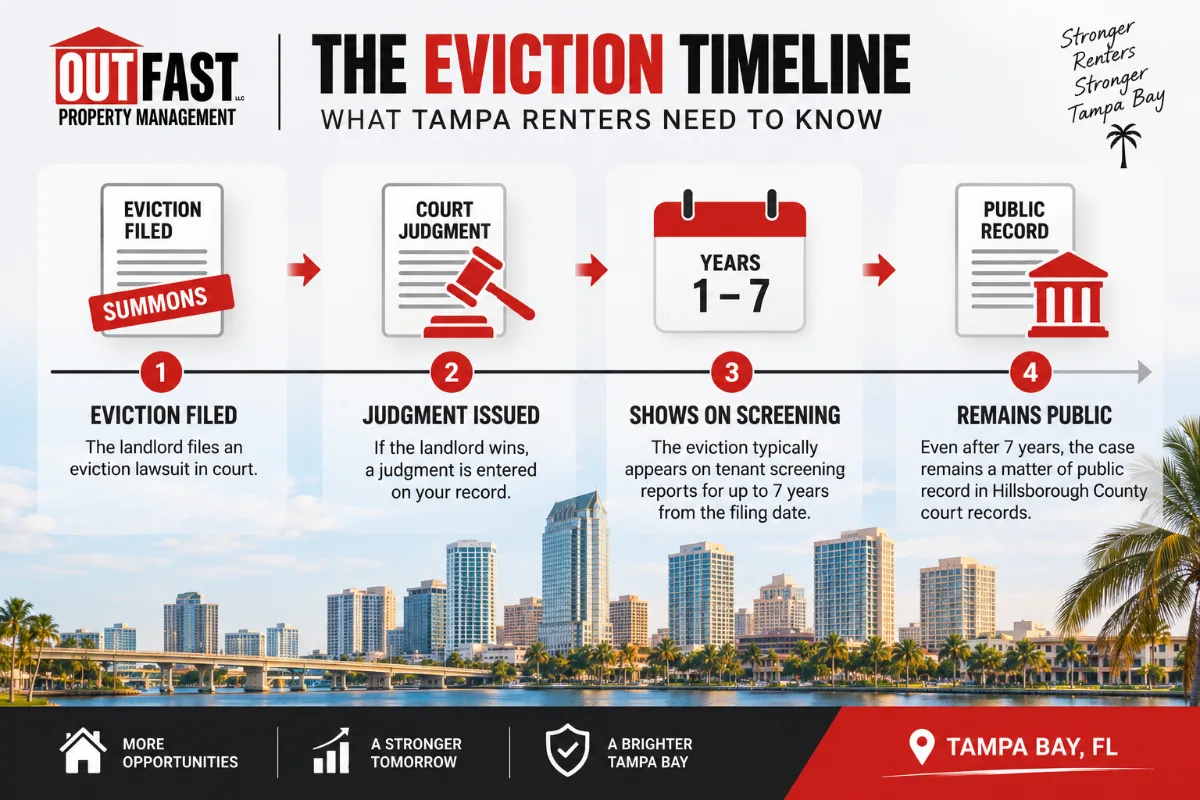
A rough timeline:
- Day 1: The landlord files. The case appears on the county docket, publicly searchable.
- Weeks 1-4: A judgment may be entered, or the case may be dismissed or settled.
- Months 1-84: The record is reportable on tenant screening reports.
- Around year 7: It should fall off screening reports.
- Indefinitely: The court file remains public and findable by anyone searching the clerk’s index by name.
So “how long does an eviction stay on your record” has two true answers: about seven years for screening, and forever for the court record. You can read the text of 15 U.S.C. 1681c and the CFPB guidance on how long eviction cases stay on a tenant screening report yourself.
Can a Florida eviction be sealed or expunged?
Mostly, no. Florida has a well-defined process for sealing certain criminal records, but no general statutory route for sealing or expunging a civil eviction case. A judge can shield a court record only in narrow circumstances under Florida’s public-access rules, and routine evictions rarely qualify. Bills to create an eviction-sealing process have been filed in past sessions without becoming general law.
What you can do is get an inaccurate screening entry corrected and get the court file to reflect the true outcome. That is a real, achievable fix, covered further down.
Preparing your application, step by step
Renting with an eviction is a documentation problem. Solve it before you apply.
1. Pull your own record first. Search the clerk of court’s public case index by name in every Florida county where you have lived, and get your free credit report at AnnualCreditReport.com. Know what a landlord will see before they see it.
2. Fix what is wrong at the source. If the docket shows the wrong outcome, ask the court about correcting it and ask your former landlord in writing to submit an update. A corrected court record eventually flows into screening data.
3. Assemble an income packet. Two to three months of pay stubs, a recent bank statement, employment verification, and – if self-employed – tax returns or a 1099 summary. Most Tampa landlords want gross income near three times the rent. If you are close, show the math.
4. Line up references who will answer the phone. A prior landlord who was not the one who evicted you is best; an employer or long-term roommate also works. Give names, numbers, and a heads-up that someone will call.
5. Write a short explanation letter. Not an excuse – a factual account with an ending. One page.
A sample explanation letter
Dear [Property Manager],
I want to be upfront about something you will see on my screening report. In March 2023, a former landlord filed an eviction against me at [address]. I had been laid off in January and fell two months behind on rent. I paid the balance in full in June 2023 and moved out without further issue; the payoff letter is attached.
Since then I have worked full time at [employer] for 22 months, earning $[amount] per month, and I have paid my current rent on time for 19 straight months. My current landlord, [name, phone], has agreed to confirm that.
I would be glad to pay an additional deposit or set up automatic payments if that helps. Thank you for reading this and considering my application.
Sincerely, [Name]
That letter works because it names the problem before the report does, shows the problem ended, and offers something concrete.
Large automated leasing systems often reject on a flag alone. Smaller communities, individual owners, and local property management companies are far more likely to read an explanation letter. Ask before you pay an application fee: “Do you review applications individually, or is approval automated?”
What to offer a hesitant landlord
A landlord’s real worry is not your past. It is next month’s rent. Every item below reduces that risk in a way they can see:
- A co-signer or guarantor. Someone with strong credit who signs the lease alongside you. Have their information ready before you are asked.
- Additional rent paid up front. First, last, and security is common and often enough on its own.
- Automatic payments. Offer to set up autopay from day one and put it in writing.
- A third-party rent guarantee. Some communities accept a paid guarantee product instead of a co-signer. Confirm the real cost before enrolling.
- A shorter initial lease. Six or seven months lets a cautious landlord say yes with a built-in checkpoint.
The most common offer is a larger security deposit, and Florida sets no statutory cap on residential deposits, so an extra half month or full month is genuinely negotiable. Before you hand over more money, though, make sure you understand Florida security deposit law and the deadlines that govern how a deposit must be held and returned. Offer all of this proactively: an applicant who arrives with a solution reads very differently from one who is only carrying an explanation.

Your rights when a landlord runs a report
Federal law gives you real, usable rights here – and most renters never exercise them.
You are entitled to an adverse action notice. If a landlord rejects you, charges more rent, requires a co-signer, or demands a larger deposit based on a screening report, they must tell you. That notice must name the screening company with its address and phone number, and inform you of your right to dispute inaccurate information and to get a free copy of the report if you request it within 60 days.
You are entitled to the report itself. The landlord may decline to share it, but the screening company must give you a free copy on request within that 60-day window.
You can dispute errors, and they must investigate. Send the screening company the correction with supporting documents – a dismissal order, a satisfaction of judgment, a paid-in-full letter. They generally have 30 days to investigate and must tell you the result in writing. The FTC’s page on disputing errors on your tenant background check report walks through it, and the broader FTC guide to tenant background checks and your rights is worth reading before you apply anywhere.
Fair housing still applies. HUD has cautioned that blanket screening policies – including automatic rejection on any eviction record regardless of outcome – can produce a disparate impact on protected classes, and has noted that cases a tenant won or that settled without fault do not necessarily show poor tenant history. See HUD’s fair housing guidance on screening applicants for rental housing. If you believe a denial was discriminatory, you can file a complaint with HUD.
Avoiding the scams that target this exact search
People searching for second chance apartments and private landlords that accept evictions are exactly who rental scammers look for – and the FTC reported roughly $65 million in consumer losses to rental scams in its December 2025 analysis. Four rules:
- Never wire money, send gift cards, or pay in cryptocurrency. That is a scam, full stop.
- Never pay for a property you have not seen in person, or to a person you have never met.
- Be suspicious of below-market rent and of the same photos appearing under different names or prices.
- Walk away from urgency. “Three other people are applying tonight, send the deposit now” is a pressure tactic, not a market condition.
Above all, verify who actually owns the property before any money moves. Look the address up on the Hillsborough County Property Appraiser’s property search or with the Pinellas County Property Appraiser and confirm the owner’s name matches the person asking you to pay. Public records also surface issues with the home itself, such as unresolved Tampa code enforcement liens. The FTC advice on rental listing scams covers more patterns worth knowing.
Any listing, locator, or “credit repair” service promising guaranteed approval with an eviction – especially one asking for an upfront fee before showing you a real unit and a real lease – is selling something it cannot deliver. Legitimate landlords screen every applicant. There is no lawful way to erase a Florida eviction case, and paying someone to try is money gone.
Where to look in Tampa Bay
Cast a wider net than the big listing apps. Individual owners and small local managers are more likely to read your file than run it through an automated filter. Before paying any application fee, ask whether the property considers applicants with an eviction and what would offset it. Then apply where you genuinely qualify on income, and lead with your documentation.
This article is general information, not legal advice, and is current as of September 2026. Screening practices, court procedures, and Florida law can change. For advice about your specific case, talk with a Florida attorney or a local legal aid office.
Out Fast Property Management manages homes across Hillsborough and Pinellas, and we review every application as a whole file, not a single flag. Browse our available rentals, apply with your income documentation and your explanation letter attached, and tell us the story up front. Honesty on the application is what gives us something to work with.
Frequently Asked Questions
Can I still rent a house in Tampa with an eviction on my record?
Usually, yes. An eviction makes approval harder, not impossible. Landlords weigh the whole application, and many will approve an applicant with an older eviction who has steady income, a clear explanation, solid references, and a willingness to put up a larger deposit or add a co-signer.
How long does an eviction stay on your record?
Under the federal Fair Credit Reporting Act, a consumer reporting agency generally cannot report civil suits and civil judgments that are more than seven years old, measured from the date of entry. So an eviction case typically drops off tenant screening reports after about seven years. The underlying Florida county court file, however, stays publicly searchable indefinitely.
What is the difference between an eviction filing and an eviction judgment?
A filing means a landlord opened a case against you in county court. A judgment means the court actually ruled – usually awarding possession, and sometimes money. Both are civil court records, and both can appear on a screening report within the seven-year window. That is why a case you won or settled can still show up.
Can a Florida eviction record be sealed or expunged?
Florida has no general statutory process for sealing or expunging a civil eviction case the way it does for certain criminal records. Sealing is possible only in narrow circumstances at a judge’s discretion under Florida’s public-access rules, and it is rarely granted for routine evictions. Legislative proposals to create an eviction-sealing process have been introduced in past sessions but have not become general law.
What are second chance apartments, and are they legitimate?
Second chance simply means a community or landlord has a path to approve applicants whose screening shows a flag – typically through a larger deposit, an extra fee, a co-signer, or a rent guarantee. It does not mean no screening. Any place promising approval before running an application is a red flag, not a second chance.
What must a landlord tell me if they deny me based on a screening report?
They must give you an adverse action notice – in writing, electronically, or orally. It has to identify the screening company by name, address, and phone number, and tell you that you can dispute inaccurate information and get a free copy of the report if you request it within 60 days.
Will paying what I owed remove the eviction from my record?
Generally no. Paying a balance or satisfying a judgment does not delete the court case or erase it from screening reports. It does help your application, though – a paid-in-full letter from the previous landlord is one of the strongest documents you can hand a new one.
How do I check my own record before I apply in Hillsborough or Pinellas?
Search the county clerk’s public case index for your name in every Florida county where you have lived, and pull your credit report from AnnualCreditReport.com. If a case shows the wrong outcome – dismissed cases marked as judgments, or duplicates – fix it at the source before a landlord sees it.


